

SYSTEM BOOT · MGHouse OÜ
MGHouse
00%
MGHouse OÜ · STUUDIO
Blog · how to build right

100 building tips

A practical builder's checklist from the MGHouse site managers: foundation, walls, roof, insulation, engineering, finishing, budget and upkeep. No fluff — only what saves money and nerves.

100 tips

FoundationFoundation
01

Start with geology, not the design

Order a geotechnical survey before choosing the foundation type: drill at least 2–3 boreholes 4–5 metres deep to determine the soil type and groundwater level. It is cheaper than any rework and decides whether you need a slab, a strip footing or piles.

FoundationFoundation
02

Account for the frost depth

In Estonia the soil freezes to a depth of 1–1.2 m, so lay the strip footing below this level or insulate it as a shallow frost-protected foundation. Otherwise frost heave will lift and crack the structure every winter.

FoundationFoundation
03

Insulated slab for frost-susceptible soils

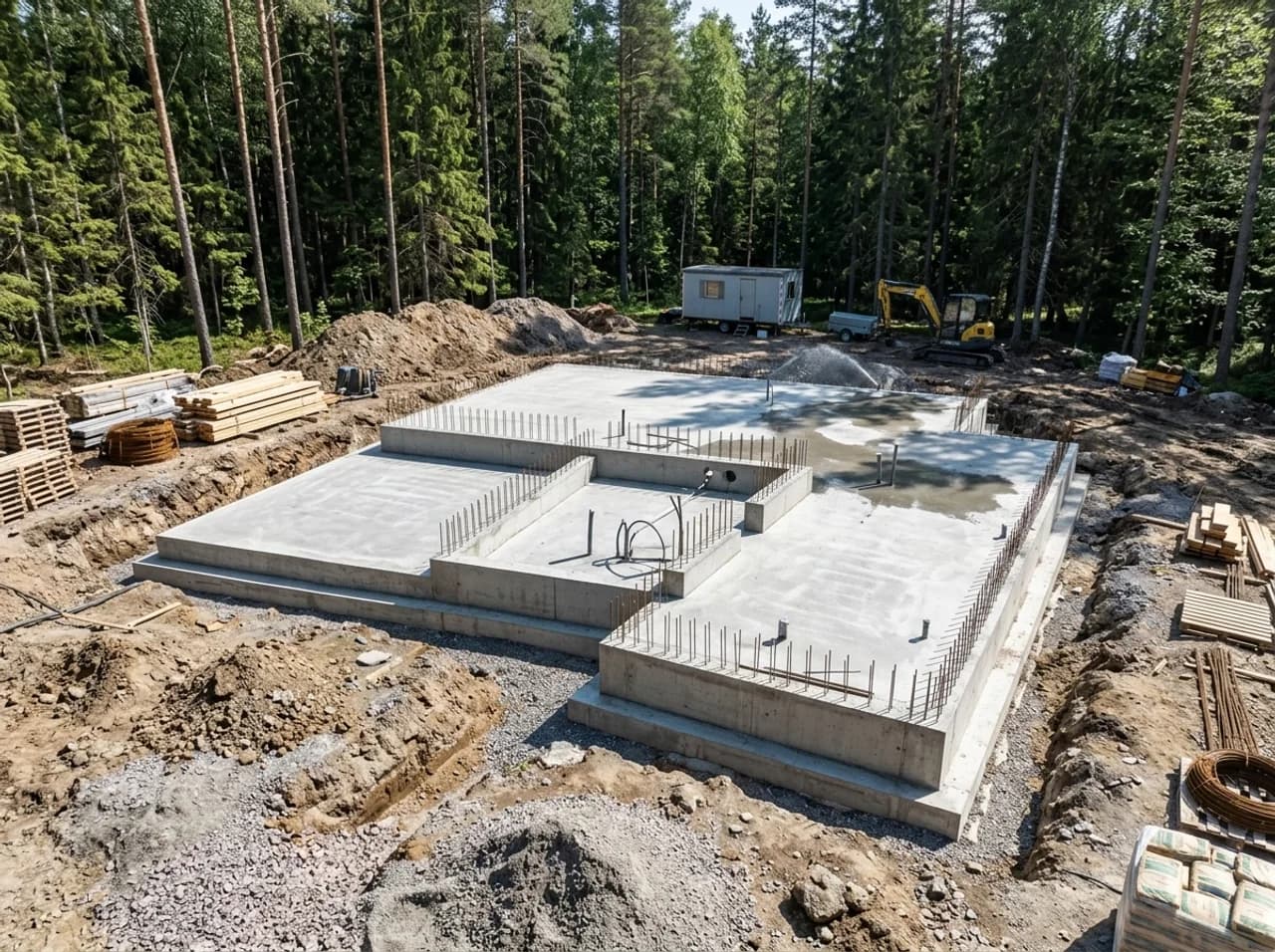
On clay and loam with a high water table an insulated Swedish slab is often more cost-effective than a strip footing: it is immune to frost heave and delivers a ready-made heated floor with its piping. A non-heaving sand or crushed-stone bed under the base is mandatory.

FoundationFoundation
04

Lay the drainage right away

A perimeter ring drain below the footing and routing water away from the house protect the foundation from undermining and basement damp. Relaying the drainage after backfilling and landscaping costs many times more than doing it straight away.

FoundationFoundation
05

The sand bed matters more than saving money

Under the base lay a 30–50 cm bed of non-heaving sand or crushed stone, compacting it layer by layer with a plate compactor. An uncompacted bed leads to uneven settlement and wall cracks within a year or two.

FoundationFoundation
06

Check the rebar before the concrete

Before the pour, check the rebar diameter, spacing and cover against the design: the concrete cover at the bottom should be 50–70 mm, otherwise the rebar will be exposed and rust. Photograph the cage — it is your argument in any dispute with the crew.

FoundationFoundation
07

Only factory concrete with a certificate

Use concrete of at least grade C25/30 (B25) delivered by mixer truck and demand a batch certificate; do not mix it by hand on site. For wet soils specify a watertightness grade of W6 and a frost resistance of F150.

FoundationFoundation
08

Control the concrete slump

On site, check the workability of the concrete: a mix that is too fluid (watered down on the spot) loses 20–30% of its strength. Do not let the driver add water to the drum for the sake of an easier pour.

FoundationFoundation
09

Vibrate, don't just spread

Compact the concrete with an immersion vibrator, not with a shovel or by shaking the rebar. Voids and honeycombing inside the foundation mean lost strength and pathways for water that cannot be fixed later.

FoundationFoundation
10

Cure the concrete for the first 7 days

After the pour, cover the foundation with film and keep it watered for at least a week, especially in heat and wind. Concrete gains strength in moisture; an over-dried top surface cracks and dusts, losing its design grade.

FoundationFoundation
11

Waterproofing around the whole contour

Separate the foundation from the walls with horizontal waterproofing and coat the vertical surfaces with bituminous or polymer mastic. Without this, moisture will rise into the walls by capillary action and cause mould in the very first year.

FoundationFoundation
12

Don't load a green foundation

Let the concrete gain strength: strip the formwork after 3–7 days, but start masonry and loading no earlier than 28 days. Rushing to erect walls on young concrete leads to settlement cracks.

FoundationFoundation
13

Run the utilities through in advance

Before the pour, install sleeves for the water, sewer and electrical inlets below the frost depth. Breaking through a finished foundation for pipes weakens the structure and almost guarantees a leak at the penetration point.

Walls and framingWalls and framing
14

Don't cut corners on the interior vapour barrier

The vapour barrier membrane is installed on the warm side of the wall, in front of the insulation, and all overlaps and junctions are sealed with special tape. Any screw hole or unsealed overlap lets humid air into the insulation — there it condenses, and within a couple of winters it rots the frame away.

Walls and framingWalls and framing
15

An air gap behind the cladding is a must

Leave a 25–45 mm gap on battens between the wind barrier and the exterior cladding — it dries the wall and carries away condensation. Siding or panelling nailed flush to the frame with no gap traps moisture, and the façade starts to grow mould and rot from within.

Walls and framingWalls and framing
16

Space studs to fit the insulation

Set the clear stud spacing at 600 mm (or 400 mm for heavy finishes) so the mineral wool slab fits snugly by friction, without trimming or gaps. Every extra cut is a thermal bridge and sagging insulation within a year.

Walls and framingWalls and framing
17

Double top plate

Make the top plate from two boards with the joints staggered over the studs — it distributes the load from the rafters and keeps the wall from buckling along the joint line. With a single plate the point load from a rafter foot pushes the stud in.

Walls and framingWalls and framing
18

Check the moisture content of the lumber

The frame is built from kiln-dried boards at 16–18% moisture, not green lumber straight from the yard. As wet boards dry in the wall they twist, tear the cladding off the screws and leave gaps that nothing will close afterwards.

Walls and framingWalls and framing
19

Bracing or sheathing for rigidity

Without diagonal bracing the frame racks into a parallelogram in the wind — let bracing into the studs or sheathe the whole wall plane with OSB/plywood. Plasterboard gives the frame no rigidity and cannot be relied upon for it.

Walls and framingWalls and framing
20

First sill plate on a damp-proof layer

Lay the sill plate on bitumen felt or EPDM over the foundation, and always use preservative-treated timber. Direct contact between wood and concrete draws moisture by capillary action — the sill plate rots first, and replacing it means opening up the entire wall.

Walls and framingWalls and framing
21

Cross insulation cuts thermal bridges

Add a 45 mm horizontal batten layer with extra insulation over the frame — it covers the timber studs, which are themselves colder than the wool. At the same time this layer hides the wiring without piercing the vapour barrier.

Walls and framingWalls and framing
22

Reinforce below windows and openings

Over every opening fit a header sized for the span, and double up the studs at the edges of the opening. A window resting on a single stud skews the frame over time, and the sashes stop closing.

Walls and framingWalls and framing
23

The exterior wind barrier must be vapour-open

On the outside of the insulation goes a diffusion-open membrane that stops wind and water but lets vapour escape. If you mix it up and fit an ordinary vapour barrier there, moisture gets trapped in the insulation from both sides and the wall never dries out.

Walls and framingWalls and framing
24

Blocking for heavy items in advance

Before the wall is closed in, fit blocking between the studs wherever the kitchen units, water heater, TV or handrails will hang. Hunting for a stud and drilling the board after the fact always means missing the frame and a pulled-out wall plug.

Walls and framingWalls and framing
25

Check the geometry by the diagonals

Check every assembled wall and opening by measuring the two diagonals — they must match, otherwise the corner is not 90 degrees. A 1 cm error at the start multiplies by the end of the build at the finishes and joints, and the rework costs the most of all.

Walls and framingWalls and framing
26

Run wiring in the service cavity

Run cables and mount back-boxes in the batten cavity on top of the vapour barrier, not through it. Every cable hole in the vapour barrier breaks the airtight envelope and becomes a point where warm air leaks into the wall.

RoofingRoofing
27

Match the pitch to the material

Not the other way around: standing-seam and membrane work from 7–12 degrees, bitumen shingle from 12, clay tile and metal tile from 14–22. First pick the minimum slope of the pitch, then choose the covering, otherwise leaks at the joints are inevitable.

RoofingRoofing
28

A ventilation gap is always mandatory

Keep a continuous 40–50 mm air channel between the insulation and the covering, running from the eaves to the ridge, with an inlet under the overhang and an outlet at the ridge. Without a through flow, moisture does not leave the insulation and the rafters rot within 5–7 years.

RoofingRoofing
29

The counter-batten makes all the difference

A 40×50 batten laid over the waterproofing along the rafters is what creates that ventilation gap and holds the membrane. Many installers skip it to save on timber — that is a direct route to condensation under the roof.

RoofingRoofing
30

Use a membrane, not a film

Over the insulation lay a vapour-permeable diffusion membrane, not a cheap pseudo-diffusion film. The film has to be hung with two gaps, but in practice it gets fitted tight against the insulation and traps moisture.

RoofingRoofing
31

Vapour barrier on the warm side

From below, on the room side, the insulation is closed off with a vapour barrier, with all seams and abutments taped. A hole in the vapour barrier at the chimney or a penetration means soaked insulation and frost on the rafters in winter.

RoofingRoofing
32

Pack the insulation tight, with no gaps

Cut the mineral wool 10–15 mm wider than the span between the rafters so it wedges in firmly with no gaps. Any gap in the insulation at Scandinavian latitudes is a thermal bridge and a point that freezes through.

RoofingRoofing
33

Eaves flashing before the waterproofing

The drip edge at the eaves is fitted so that the membrane runs out onto it and sheds condensation into the gutter rather than onto the fascia board. A mixed-up installation order drives water under the overhang and wets the facade.

RoofingRoofing
34

Snow guards above the entrance

In our climate, tubular snow guards are mandatory above entrances, walkways and parking, fastened into the battens through the wave. An avalanche of wet snow off a metal roof maims people and wrecks the gutters.

RoofingRoofing
35

The chimney junction is a wet zone

The junction with the chimney is made with a back-gutter saddle above the chimney and a flashing set into a chase, not with sealant applied on top. The most common leak in Estonian houses is the chimney, precisely because it gets done in a hurry.

RoofingRoofing
36

Screws strictly into the trough

Fasten metal tile and profiled sheet with a roofing screw and EPDM washer into the lower trough, without over-tightening the washer. A washer that is over-tightened or driven into the crest lets water through and leaves rust streaks within a year.

RoofingRoofing
37

Walk only over the battens

When installing, step on the covering in the trough of the wave and over the line of the battens, wearing soft footwear. Dents and polymer coating torn off by heels become corrosion hotspots that show up after a couple of winters.

RoofingRoofing
38

Carry out an inspection in spring

Once a year after the snow has gone, check the sealant at the ridge and the gable ends, the condition of the washers, and that the gutters and valleys are clean. A roof lasts 40–50 years only with inspection — a valley clogged with leaves floods the attic in a single downpour.

InsulationInsulation
39

A continuous envelope without gaps

The thermal envelope must be unbroken: the attic, walls and plinth are insulated as one continuous line without interruptions. A single thermal bridge at one junction cancels out the insulation quality of the entire rest of the building shell.

InsulationInsulation
40

Vapour barrier on the inside, windproofing on the outside

The vapour barrier film goes on the warm side (the interior), and the wind-and-moisture barrier on the outdoor side. Mix up the layers and the insulation will soak up moisture and the frame will start to rot within a couple of seasons.

InsulationInsulation
41

Tape the vapour-barrier seams

Film overlaps on their own are not airtight — every seam and junction around openings must be sealed with proper jointing tape, not ordinary adhesive tape. A single untaped seam sends a jet of warm, moist air into the insulation.

InsulationInsulation
42

Don't skimp on the attic

Most heat escapes through the roof, so the horizontal ceiling of a cold attic is insulated with a generous margin — 400–500 mm of mineral wool or cellulose wool. These are the cheapest square metres of insulation and the fastest payback.

InsulationInsulation
43

Insulation in two cross-laid layers

Lay mineral wool in the frame not as one thick layer but as two, with the seams staggered and overlapping. This way you close the gaps between the slabs and eliminate thermal bridges along the frame studs.

InsulationInsulation
44

The plinth-and-apron junction

Insulate not only the wall but also the plinth, carrying the extruded polystyrene out onto the apron. In the Estonian climate this prevents the foundation from freezing and protects against frost heave of the soil.

InsulationInsulation
45

Breaking the thermal bridge under the sill

The area under the window and the reveals of openings are a classic spot for freezing. Foam-fill the installation gap completely and add a strip of insulation along the reveals, otherwise come winter you'll get black mould in the corners of the window.

InsulationInsulation
46

Warm window installation using pre-compressed sealing tape

A window is not set on foam alone: the inner joint is sealed with a vapour barrier and the outer one with pre-compressed sealing tape or a diffusion tape. Bare foam breaks down under rain and sun within 2–3 years and the joint starts to let drafts through.

InsulationInsulation
47

A ventilation gap in the facade is a must

Between the windproofing and the outer cladding leave a ventilated gap of 25–40 mm on a counter-batten. Without it, moisture cannot escape from the wall and the insulation gets damp even with flawless membranes.

InsulationInsulation
48

Calculate for the dew point

Choose the layer thicknesses so that the dew point falls within the insulation or the ventilation gap, not in the load-bearing structure. It's a 10-minute calculation that decides whether the house lasts 50 years or rots away.

InsulationInsulation
49

Supply-and-exhaust ventilation with heat recovery

An airtight, energy-efficient house must not be left without controlled ventilation — install a heat recovery unit that recovers up to 80–90% of the heat from the exhaust air. Otherwise the savings on heating turn into stuffiness and condensation on the windows.

InsulationInsulation
50

A thermal camera before handover

Before the finishing stage, scan the shell with a thermal camera in cold weather — it instantly reveals drafts, missed insulation and thermal bridges. Fixing a defect at this stage is many times cheaper than opening up a finished wall.

InsulationInsulation
51

A Blower Door airtightness test

A house's airtightness is checked with a Blower Door test before the walls are closed up, so that every gap around the envelope can be found and sealed. For an energy-efficient house in Estonia the target n50 figure is around 1.0 or lower.

Engineering SystemsEngineering Systems
52

Utilities before the screed and cladding

All water, sewage, underfloor heating and electrical runs are routed and tested BEFORE the screed is poured and the walls are closed up. Reworking a concealed utility costs 5–10 times more than laying a spare conduit on time.

Engineering SystemsEngineering Systems
53

Photograph concealed runs

Before the screed and closing up the walls, photograph every utility line with a tape measure in frame and dimensions tied to the walls. A year later, when drilling for a shelf or renovating, these photos will save the underfloor heating pipe and cable from the drill.

Engineering SystemsEngineering Systems
54

Sewage: slope and inspection points

Lay horizontal drains with a fall of 2–3 cm per metre for Ø110 and fit an inspection point at every bend and at the base of the stack. Without inspection points, any blockage turns into opening up the floor or wall.

Engineering SystemsEngineering Systems
55

Water in a radial layout to the manifold

Distribute water in a radial layout from the manifold: each fixture gets its own continuous run with no concealed joints inside the wall. Joints only at the manifold and at the fixture — a leak under the tiles is ruled out.

Engineering SystemsEngineering Systems
56

Sleeves where pipes pass through structures

Run pipes through the foundation, floor slabs and framed walls only inside sleeves with a clearance gap. Otherwise the concrete and the building's settling will crush the plastic, and in winter a frozen water inlet without an insulated sleeve will burst.

Engineering SystemsEngineering Systems
57

Balanced supply-and-extract ventilation with heat recovery

In an energy-efficient house this airtight, natural ventilation does not work — you need a mechanical supply-and-extract unit with a heat recovery exchanger. It returns up to 80–90% of the heat and eliminates condensation and mould in the corners.

Engineering SystemsEngineering Systems
58

Round, insulated air ducts

Use rigid round ducts, not flexible corrugated hose: corrugated hose hums, collects dust and chokes the airflow. Supply and extract ducts in the cold zone (the attic) must be insulated, otherwise condensation forms on them.

Engineering SystemsEngineering Systems
59

Underfloor heating — separate loops

Keep the length of a single water underfloor heating loop within 80–100 m and group the loops by room with separate control. One long loop for a whole floor leaves a cold far end and rooms you cannot regulate.

Engineering SystemsEngineering Systems
60

Heat pump sized for low temperature

For an air-source or ground-source heat pump, design a low-temperature system (underfloor heating at 35 °C, not radiators at 70 °C). At a low supply temperature the pump runs at a COP of 4–5 instead of 2, and the winter bill drops several-fold.

Engineering SystemsEngineering Systems
61

Panel with 30% spare capacity

Plan the electrical panel with a reserve of at least 30% free modules for the future: EV charging, an extra circuit, a solar panel. Adding a breaker to an empty row takes minutes; replacing a packed panel takes a day and money.

Engineering SystemsEngineering Systems
62

Dedicated circuits for high-power loads

The hob, oven, water heater, heat pump and kitchen sockets each run on their own circuit with their own breaker. A single shared kitchen circuit trips the protection under simultaneous load and overheats the wire.

Engineering SystemsEngineering Systems
63

RCD on wet areas and outdoors

All socket groups, bathrooms, the kitchen and outdoor points are protected by a 30 mA RCD (or RCBO). This is not a box-ticking formality for handover but the thing that actually keeps a fault to the enclosure from electrocuting you.

Engineering SystemsEngineering Systems
64

Spare conduits while the walls are open

While the frame is open, pull in empty spare conduits: internet to every room, a cable to the gate, power for a carport and air conditioner, a conduit from outside to the panel. One day of laying spare conduits saves years of chasing channels through a finished house.

FinishingFinishing
65

Utilities first, finishing later

Before the final finishing, run the wiring, water and sewage lines, and photograph every concealed run in the walls with a tape measure for reference. Without this, the first drilling for a shelf will pierce a pipe or cable.

FinishingFinishing
66

Let the house settle

Before the final finishing, wait out one warm season with the heating on so the frame and materials can shrink and reach their working moisture level. Paint and tiling applied to damp structures will crack along the joints within six months.

FinishingFinishing
67

Wet areas need two layers of waterproofing

In bathrooms and shower areas, carry the liquid-applied waterproofing up the walls to at least 20 cm above the floor and seal all corners and junctions with elastic waterproofing tape. In a timber-frame house a leak rots unnoticed and only reveals itself once mould appears.

FinishingFinishing
68

Underfloor heating in tiled areas

Plan for water-based or electric underfloor heating in the hallway, bathrooms and kitchen, and under laminate or parquet only with caution and only a compatible type. In the Estonian climate, cold tiles underfoot are the number one complaint after the first winter.

FinishingFinishing
69

Plan outlets with a margin

For each functional zone, plan a third more outlets than seems necessary, and be sure to place blocks at the head of the bed, along the kitchen backsplash and at the desk. Extension cords running along the skirting are the sign of a poor design.

FinishingFinishing
70

Design lighting in scenes

Split general, task and accent lighting into separate circuits and dimmers before any chasing is cut, and fit two-way switches in the bedroom and hallway. A single ceiling light per room ruins even the most expensive renovation.

FinishingFinishing
71

Ventilation matters more than wallpaper

In an airtight modern house install a supply-and-exhaust unit with heat recovery and never hide the bathroom extract behind decor. Without forced air exchange, condensation will settle on the windows and in the corners of the exterior walls.

FinishingFinishing
72

Decide on wet cleaning in advance

Choose flooring and skirting for the real-life scenario: children, a dog, mud tracked in from outside. A light matte lacquer on oak in the entryway leading from the yard means re-sanding every month.

FinishingFinishing
73

Bring materials together on one level

Plan the junctions of tile, laminate and thresholds against the finished floor level in advance so that transitions between rooms sit on one plane without thresholds. Coverings of differing thickness, if not calculated, leave a step in the doorway.

FinishingFinishing
74

Backing for heavy items in advance

In timber-frame walls, before the plasterboard goes up, fit plywood backing where the TV, kitchen cabinets, handrails and water heater will hang. A plug in plasterboard alone won't hold that load, and getting to it later means opening up the wall.

FinishingFinishing
75

Buy finishing materials in one batch

Buy tile, laminate, paint and grout from a single batch with a 10–15 percent surplus, checking the batch number on the packaging. Tile bought later almost always differs in shade and calibration, and it shows in the light.

FinishingFinishing
76

Inspect the finish in daylight

Check walls, paintwork and tiling by day under raking light from the window or a torch held along the surface, and check flatness with a two-metre straightedge. Filler defects and waviness on a wall are only visible under side lighting.

Project and budgetProject and budget
77

Build only to a complete design

Do not start without a full set of working drawings (structure, details, sections). Building from a rough sketch always leads to rework and cost overruns at the stage when changes are already expensive.

Project and budgetProject and budget
78

Soil survey before the foundation

Order geotechnical surveys and test drilling before designing the foundation. Soil type and groundwater level determine the foundation solution — saving here turns into cracks within two years.

Project and budgetProject and budget
79

Check the detailed plan

Before buying a plot, study the detailed plan and restrictions: height limits, build-up ratio, setbacks from boundaries, protection zones. A beautiful plot may turn out to be unsuitable for your dream house.

Project and budgetProject and budget
80

Building permit before you start

Obtain a building permit (ehitusluba) through the EHR register before bringing in materials. Building without a permit risks fines and a demolition order, and legalising it after the fact is harder and more expensive.

Project and budgetProject and budget
81

Set aside a 15 percent reserve

Always add a 10–15% cushion on top of the estimate for the unexpected: hidden works, changes along the way, rising material prices. Without a reserve the build stalls halfway.

Project and budgetProject and budget
82

Estimate broken down by stage

Demand an estimate broken down by stage and line item, not a single «turnkey house» figure. Transparent detail lets you control payments and compare contractors honestly.

Project and budgetProject and budget
83

Count the full cost

In the house budget include not just the shell but also utility connections (water, electricity, sewerage), landscaping, fencing and the driveway. «Hidden» utility connections easily add 10–20% to the price.

Project and budgetProject and budget
84

Fix the price in the contract

Sign a contract with a fixed price and a clear description of the scope of work, not «as incurred». Attach a materials specification as a separate annex, so they cannot be swapped for a cheaper substitute.

Project and budgetProject and budget
85

Payment schedule by stage

Tie payments to completed stages (foundation, shell, roof), not to the calendar. Never pay more than has actually been done — an advance paid «upfront» strips you of leverage.

Project and budgetProject and budget
86

Build the energy class into the design

Define the required energy efficiency class (high for new dwellings in Estonia) at the start of the design. Bringing insulation and ventilation up to standard after the fact costs more than building it into the structure from the outset.

Project and budgetProject and budget
87

Hidden works acceptance acts

Photograph and sign acceptance acts for everything that will later be covered up: waterproofing, reinforcement, insulation, utility routing. After concreting and cladding it is almost impossible to prove a defect.

Project and budgetProject and budget
88

Design author and owner supervision

Commission independent construction supervision (omanikujärelevalve) — in Estonia it is mandatory for many projects. A specialist's fresh eye on the client's side pays for itself at the very first defect.

Plot and facadePlot and facade
89

Do the geotechnical survey before the design

Order a geotechnical survey of the plot (boreholes, groundwater level) before the foundation goes into the design. Quicksand or peat under the building footprint turns the whole budget upside down, and it is cheaper to find out on paper than after the pour.

Plot and facadePlot and facade
90

Raise the floor level above the ground

Set the finished floor level at least 30–50 cm above the ground and the apron. This protects the plinth from rain splashes, the snow bank against the wall, and spring flooding from meltwater.

Plot and facadePlot and facade
91

Drainage around the foundation perimeter

A perimeter drain leading to a drainage well is laid at the same time as the foundation, while the trench is still open. Redoing it later means digging along the finished house again, which costs twice as much.

Plot and facadePlot and facade
92

Slope the plot away from the house

Grade the soil so the surface falls away from the walls at 2–3 cm per metre over the first 2–3 metres. Water diverted at the start never reaches the foundation or the basement.

Plot and facadePlot and facade
93

A ventilation gap behind the facade is a must

Under a ventilated facade (board, planken, fibre cement) leave a 25–40 mm ventilation gap with air intake at the bottom and outlet at the top. Without it the insulation collects condensation and the cladding rots within a couple of seasons.

Plot and facadePlot and facade
94

Roof overhangs protect the facade

Do not skimp on the overhangs: a 50–70 cm projection shields the wall and windows from driving rain and sun. A house with stubby overhangs soils and soaks its facade many times faster, especially on the south and west sides.

Plot and facadePlot and facade
95

Separate the plinth from the timber

Keep the bottom facade board at least 30 cm above the apron, and finish the plinth zone with stone, clinker or render over insulation. Timber right at ground level always wicks moisture and darkens first.

Plot and facadePlot and facade
96

Set windows in the insulation plane

Mount the windows in the plane of the insulation, not flush with the wall, and always seal the joint with installation tape both outside and inside. This eliminates thermal bridges and frozen reveals in Estonian frosts.

Plot and facadePlot and facade
97

Apron with a slope and a base layer

Make the apron at least as wide as the roof overhang, sloped away from the house, with an XPS insulation layer beneath it. An insulated apron stops the soil from heaving and tearing the foundation during temperature swings.

Plot and facadePlot and facade
98

Plan for snow and ice in advance

Provide snow guards above the entrance, walkways and terrace already at the roofing stage. A slab of snow sliding onto someone's head or a car is not theory but an annual winter reality in Estonia.

Plot and facadePlot and facade
99

Keep service access to the utilities open

Bring every serviceable component — underfloor heating manifolds, filters, shut-off valves, the heat-recovery unit — out to accessible spots with access hatches. A valve walled into the wall will one day force you to tear open the finishes.

Plot and facadePlot and facade
100

The facade needs an annual walk-around

Walk around the house once a year: clean the stormwater drains and gutters, check the sealant around the windows and the ventilation gap vents, touch up the board ends. Half an hour of inspection in autumn is cheaper than repairing a soaked wall three years later.

Get a consultation

Let's talk about your project

Leave a request — we'll prepare a free quote and get in touch within one working day.

  • Free quote
  • Turnkey with warranty
  • Reply within 1 business day

We usually reply within 1 business day.